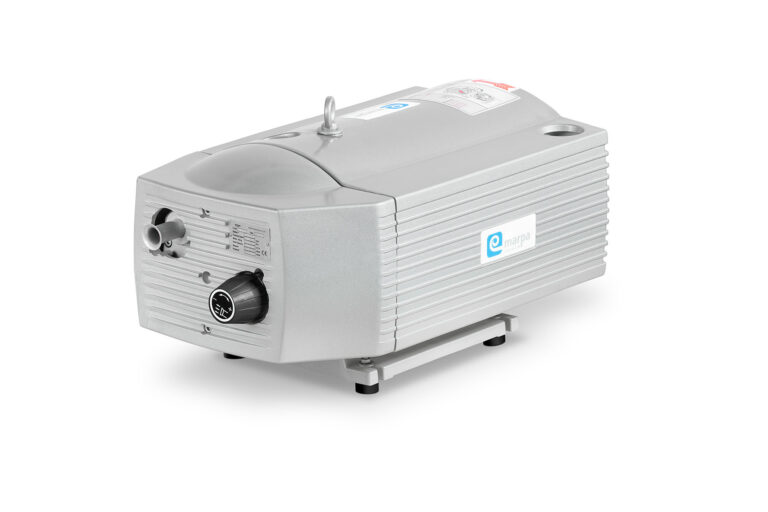
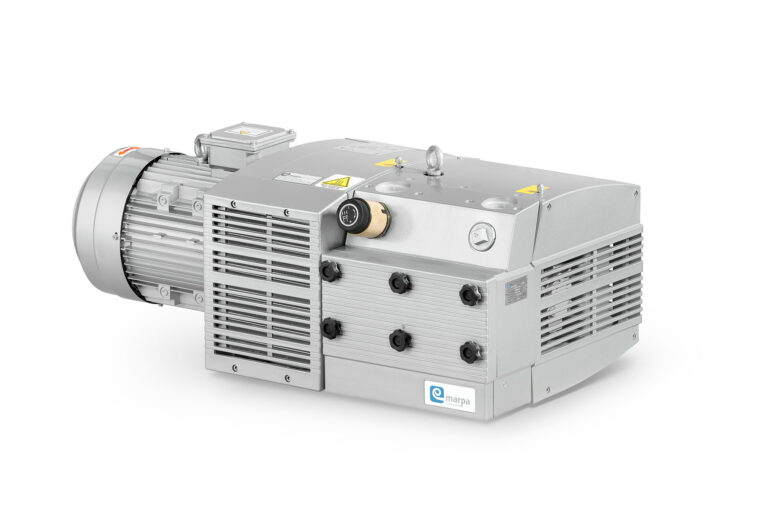
Dry running rotary vane compressors generate clean, completely oil-free compressed air, with no risk of process contamination. They share the technology of dry running rotary vane vacuum pumps, but geared towards generating pressure, making them a robust, easy-to-maintain solution for industrial applications requiring oil-free compressed air.
| Applications / Technology | MVS-P | MVD | MV | MVS-V | MVC | MVCP | MVS-VP | MVR | MVF |
|---|---|---|---|---|---|---|---|---|---|
| Packaging and food industry | ○ | ○ | ● | ○ | ● | ● | |||
| Laboratory and scientific | ● | ○ | ○ | ○ | ● | ||||
| Heavy industry and metallurgy | ○ | ● | ● | ○ | ● | ||||
| CNC, woodworking and graphic arts | ● | ○ | ● | ● | ● | ● | |||
| Environment and transport | ● | ● | ● | ○ | |||||
| Oil and gas | ○ | ● | ○ | ● | ● | ||||
| Medical and hospital | ● | ● | ● | ||||||
| Semiconductors and coatings | ● | ● | ● |
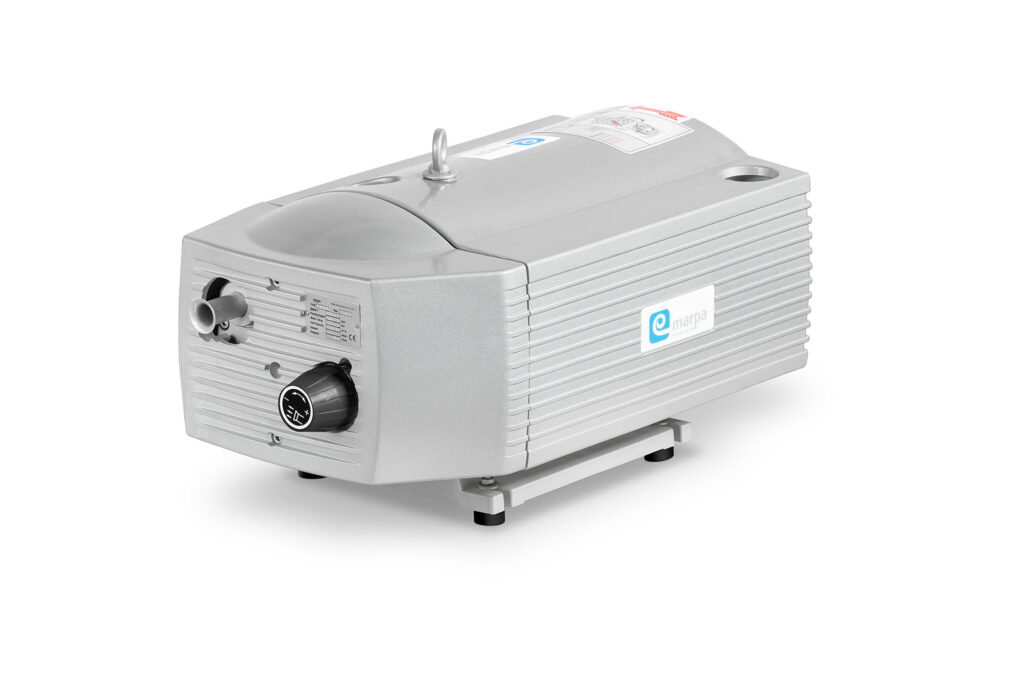
MVS-P: Dry running rotary vane compressors
MVD: Two-stage lubricated rotary vane vacuum pumps
MV: Lubricated rotary vane vacuum pumps
MVS-V: Dry running rotary vane vacuum pumps
MVC: Claw vacuum pumps
MVCP: Claw compressors
MVS-VP: Combined dry running rotary vane pumps (vacuum and pressure)
MVR: Roots vacuum pumps
MVF: Diaphragm vacuum pumps
It is a positive displacement compressor in which a rotor fitted with graphite vanes turns eccentrically inside a stator, with no oil in the pumping chamber. It draws in air from the atmosphere and delivers it at a higher pressure, with the self-lubricating graphite vanes providing both sealing and lubrication through continuous contact with the stator wall, with no need for an external supply of lubricant. The result is completely oil-free compressed air, ideal for processes requiring a clean, contamination-free supply.
Mechanically, they are the same machine: what changes is how it is connected to the process. In a vacuum pump, the inlet is connected to the chamber to be evacuated and the discharge is vented to atmosphere, generating vacuum at the suction point. In a compressor the opposite happens: the inlet draws air from the atmosphere and the discharge is connected to the process or receiver, delivering the air at a pressure above atmospheric. That is why, in dry running rotary vane technology, the same construction is marketed as a vacuum pump or as a compressor depending on the intended use. If you are looking for a vacuum pump with this technology, see our MVS-V series.
No, it does not require oil in the pumping chamber. Sealing and lubrication at the point of contact between the vanes and the stator are provided by the vane material itself: the self-lubricating graphite maintains continuous low-friction contact with the stator wall with no need for an external supply. This is the key feature of the technology: as the compressed air never comes into contact with any lubricant, the supply is completely clean. The bearings and components outside the chamber do have their own lubrication, but it is isolated from the air circuit and does not affect the quality of the compressed air delivered to the process.
Both technologies generate completely oil-free compressed air, but with real differences. The dry running rotary vane compressor is more compact and technically straightforward, and offers a lower initial investment, making it ideal for decentralised applications and moderate ranges. The claw compressor, on the other hand, operates without internal contact, which gives it higher energy efficiency, lower wear and lower maintenance in the medium and long term, in exchange for a higher initial investment. If your process requires continuous operation with optimised operating costs, see our MVCP series of claw compressors.
Dry running rotary vane compressors work in the low and medium pressure range. In our MVS-P series, the working pressure reaches up to 1.5 bar depending on the model, which is the ideal range for decentralised applications —aeration, pneumatic conveying, packaging processes, supplying clean air at specific points on a production line— where the high pressures typical of a centralised compressed air network are not required. If your application needs significantly higher pressures, contact us and we will guide you towards the most suitable technology within our range or that of our partners.
Yes, natural wear of the vanes generates a small amount of graphite dust which is carried along with the discharged compressed air. In the vast majority of industrial applications this amount is negligible and poses no problem, as graphite is inert and non-reactive. In processes that are particularly sensitive to particle contamination —certain high-purity pharmaceutical applications, advanced semiconductors or direct-contact food processes—, it is advisable to install a filter downstream of the compressor to retain the particles before they reach the process. It is a simple, economical solution that retains all the benefits of oil-free operation.
Maintenance is simple and clean. It is mainly limited to the periodic replacement of the graphite vanes —which are the predictable wear item of this technology— and cleaning or replacing the inlet filter. There is no oil to manage, no oil filters, no separators and no hazardous waste from lubricant, which significantly simplifies the work and reduces operating costs compared with lubricated compressors. The actual vane replacement interval depends on the operating conditions and the model; our technical team can advise you on your specific application.
Dry running rotary vane compressors are ideal for industrial applications requiring clean, oil-free compressed air at moderate pressures. Typical applications: pneumatic conveying of granules, powders or food products; packaging processes requiring clean air for filling or sealing; aeration of tanks and vessels in water treatment and industrial processes; CNC, woodworking and graphic arts for blowing and cleaning functions; and in general any decentralised process where the absence of oil contamination and simple maintenance are essential requirements.