Roots vacuum pumps

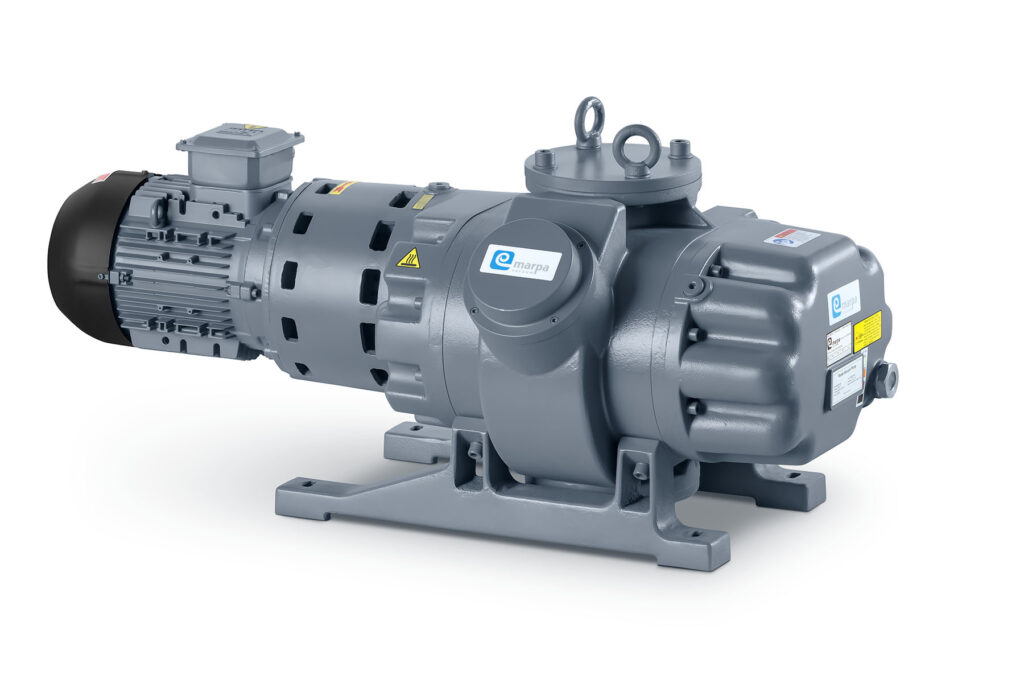
Roots blowers (technically positive displacement machines) are oil-free in the pumping chamber and designed to move large volumes of air or gas under pressure or moderate vacuum. They stand out for their robustness, mechanical simplicity and ability to cover very wide flow ranges, making them a common solution in industrial air conveying and circulation applications.
Applications of Roots pumps

● Optimal solution ○ Possible solution depending on the process
Applications / Technology MVR MVD MV MVS-V MVC MVCP MVS-P MVS-VP MVF
Packaging and food industry ○ ● ○ ● ○ ●
Laboratory and scientific ○ ● ○ ○ ●
Heavy industry and metallurgy ● ○ ● ● ○
CNC, woodworking and graphic arts ○ ● ● ● ● ●
Environment and transport ● ● ● ○
Oil and gas ● ○ ● ○ ●
Medical and hospital ● ● ●
Semiconductors and coatings ● ● ●

MVR: Roots vacuum pumps

MVD: Two-stage lubricated rotary vane vacuum pumps

MV: Lubricated rotary vane vacuum pumps

MVS-V: Dry running rotary vane vacuum pumps

MVC: Claw vacuum pumps

MVCP: Claw compressors

MVS-P: Dry running rotary vane compressors

MVS-VP: Combined dry running rotary vane pumps (vacuum and pressure)

MVF: Diaphragm vacuum pumps

Advantages of our Roots pumps

  • Higher pumping speed and lower system ultimate pressure
  • Contact-free, oil-free operation in the pumping chamber
  • Robust, mechanically simple construction
  • Low wear and long service life, as there is no internal friction
  • Wide range of sizes to match flow and ultimate pressure to each process
More advantages of our MVR series

Frequently asked questions

It is a positive displacement vacuum pump consisting of two lobe-profile rotors that turn synchronously in opposite directions, without touching each other or the housing and with no oil in the pumping chamber. Its key feature is that it is not a stand-alone pump: it is designed to work in series with a primary (backing) vacuum pump, upstream of it, to boost its performance. That is why it is called a booster (amplifier) or "support" pump: it does not generate vacuum on its own, but enhances and improves the operation of the backing pump it works with.

No. The Roots booster pump is not designed to work without a backing pump, and doing so would compromise its operation. The Roots pump cannot discharge directly against atmospheric pressure, as it does not have sufficient internal compression to do so. Without a backing pump to create the initial vacuum and remove the partially compressed gas, the Roots pump would quickly overheat and the system's ultimate pressure would be very poor. The backing pump is what allows the Roots pump to work in its optimum range, i.e. the fine vacuum range where a backing pump on its own would lose effectiveness.

The Roots pump is installed upstream of the backing pump, i.e. closer to the chamber to be evacuated. The gas path is: process → Roots → backing pump → atmosphere. The Roots pump draws in the gas already rarefied by the backing pump and partially compresses it, delivering it to the backing pump inlet; the backing pump then completes the compression up to atmospheric pressure and expels it. It is important to understand that a booster is not a stand-alone machine, but a system made up of two pumps working in series, where each one does what the other cannot do efficiently on its own.

There are two key advantages. The first is a very significant increase in pumping speed in the fine vacuum range: the system evacuates far more volume per unit of time than the backing pump would on its own. The second is a substantial improvement in the ultimate pressure achievable by the system, in the order of one to two orders of magnitude below what the backing pump would offer unassisted. In practical terms, this translates into much shorter cycle times —a decisive factor in industrial processes where pumping time is cost— and the ability to reach vacuum levels that are simply not achievable with a stand-alone backing pump. It is always worthwhile when your process requires fine vacuum or when pumping time is a critical factor.

In combination with a suitable backing pump, a system with an MVR series Roots booster reaches vacuum levels in the order of 10⁻⁴ mbar, well within the fine vacuum range. For comparison: a single-stage lubricated rotary vane pump reaches approximately 10⁻¹ mbar, a two-stage pump reaches the order of 10⁻³ mbar, and by adding a Roots booster the set can reach 10⁻⁴ mbar or even deeper. It is the right solution when the process demands vacuum levels that no rotary vane backing pump can reach on its own.

Maintenance is very low. As there is no contact between the rotors or with the housing, there is no internal friction and there are no wear parts in the pumping chamber: no vanes to replace and no oil in the chamber to change. Routine maintenance is limited to changing the gearbox oil that synchronises the rotors, at very long intervals —in the order of tens of thousands of operating hours—, and periodically checking the filters. This absence of internal friction gives a Roots pump one of the longest service lives on the market among vacuum technologies, making it a particularly cost-effective investment in continuous industrial processes.

Mechanically, they are the same machine: two synchronised lobe rotors, contact-free and with no oil in the chamber. What changes is the operating range and the function. The Roots blower works close to atmospheric pressure —under pressure or moderate vacuum— to move large volumes of air or gas, in applications such as water aeration, pneumatic conveying or industrial air circulation processes. The Roots booster pump, on the other hand, works in fine vacuum, always in series with a backing pump, with the aim of boosting the performance of the vacuum system. They are the same machine, but with completely different applications and contexts. If you are looking for a solution for pressure or moderate vacuum, see our Roots blowers page.