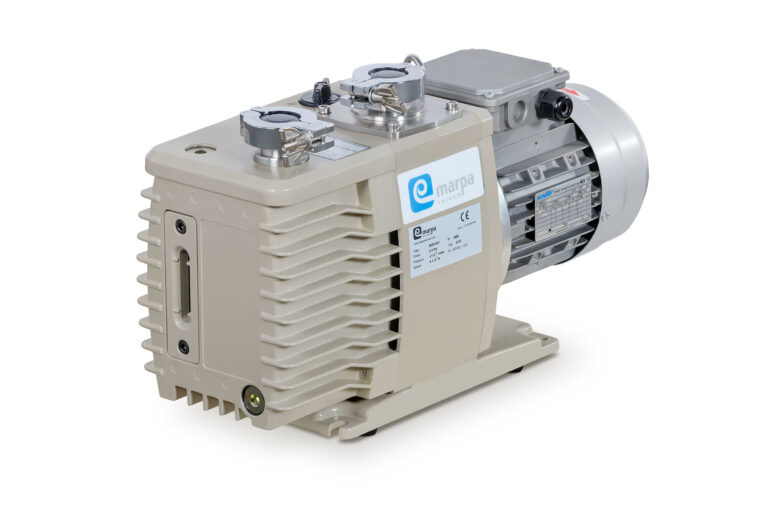
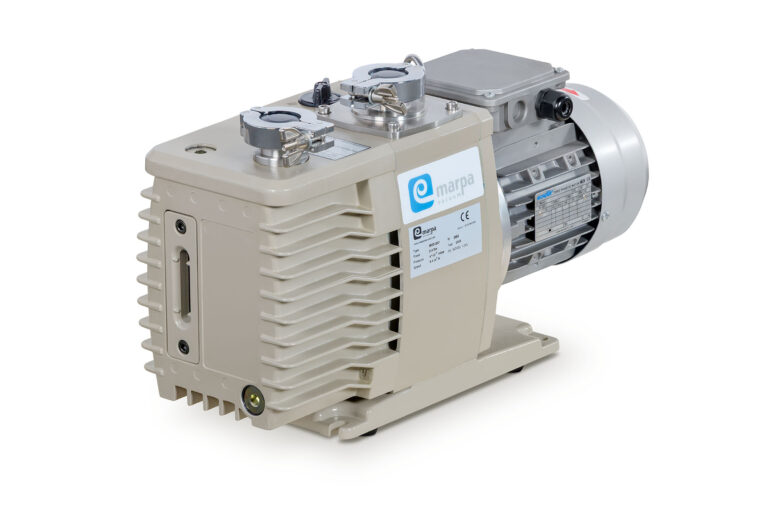
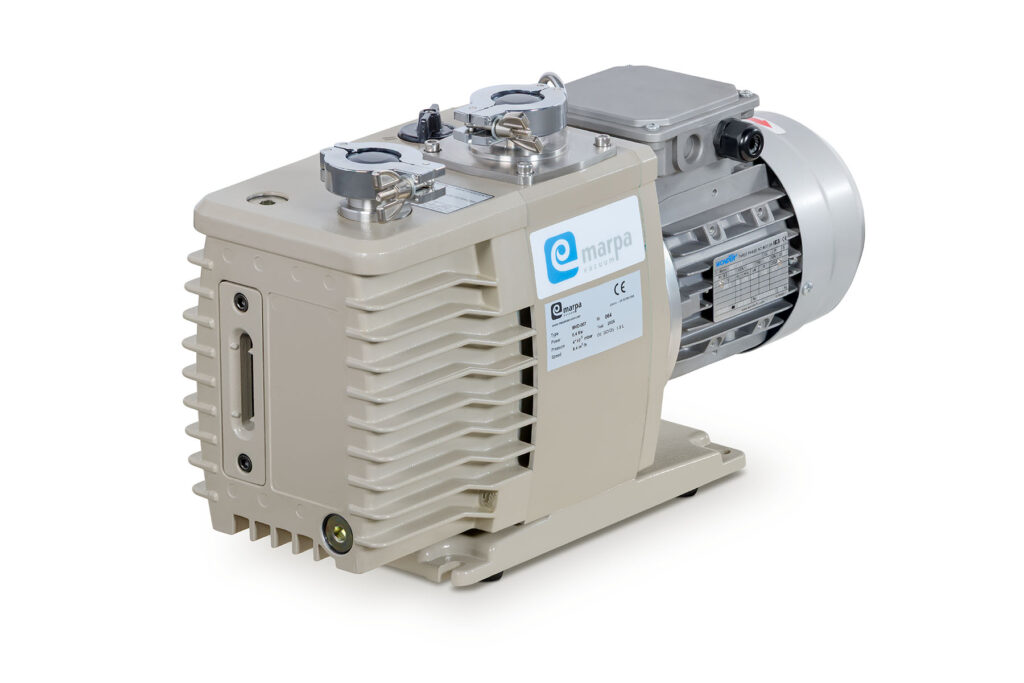
Two-stage lubricated rotary vane pumps are an evolution of conventional lubricated rotary vane technology, designed to reach fine vacuum levels. The two compression stages make it possible to achieve vacuum levels in the order of 10⁻³ mbar, an improvement of roughly two orders of magnitude over single-stage versions, which makes them particularly suitable for laboratories, analytical chemistry and industrial applications requiring a deep vacuum.
| Applications / Technology | MVD | MV | MVS-V | MVC | MVCP | MVS-P | MVS-VP | MVR | MVF |
|---|---|---|---|---|---|---|---|---|---|
| Packaging and food industry | ○ | ● | ○ | ● | ○ | ● | |||
| Laboratory and scientific | ● | ○ | ○ | ○ | ● | ||||
| Heavy industry and metallurgy | ○ | ● | ● | ○ | ● | ||||
| CNC, woodworking and graphic arts | ○ | ● | ● | ● | ● | ● | |||
| Environment and transport | ● | ● | ● | ○ | |||||
| Oil and gas | ○ | ● | ○ | ● | ● | ||||
| Medical and hospital | ● | ● | ● | ||||||
| Semiconductors and coatings | ● | ● | ● |
MVD: Two-stage lubricated rotary vane vacuum pumps
MV: Lubricated rotary vane vacuum pumps
MVS-V: Dry running rotary vane vacuum pumps
MVC: Claw vacuum pumps
MVCP: Claw compressors
MVS-P: Dry running rotary vane compressors
MVS-VP: Combined dry running rotary vane pumps (vacuum and pressure)
MVR: Roots vacuum pumps
MVF: Diaphragm vacuum pumps
It is a positive displacement vacuum pump in which the gas passes through two compression chambers in series instead of just one. Mechanically, it is the same machine as a single-stage lubricated pump —a rotor with sliding vanes and an oil film that seals the assembly—, but the double compression allows it to reach much deeper vacuum levels, in the order of 10⁻³ mbar.
The main difference is the ultimate pressure: a single-stage pump reaches around 0.1 mbar, whereas a two-stage pump reaches 10⁻³ mbar, roughly two orders of magnitude deeper. Two-stage pumps also usually come with a gas-ballast valve as standard, which is essential for pumping condensable vapours without degrading the oil. Single-stage pumps, on the other hand, cover a much wider flow range (up to 3,000 m³/h compared with a few tens of m³/h for two-stage pumps) and are the usual choice for industrial processes that do not require fine vacuum.
It depends on the vacuum level your process requires. If you need standard industrial process vacuum (above approximately 0.5 mbar), a single-stage pump is more cost-effective and sufficient. If your process requires fine vacuum (below 10⁻¹ mbar) —such as analytical laboratories, chemistry, freeze-drying, spectrometry or deposition— a two-stage pump is the right choice. As a rule of thumb: if your process calls for vacuum levels in the order of 10⁻² mbar or deeper, you need a two-stage pump.
No. The two compression stages only deliver their real advantage with oil-film sealing; without oil, the sealing between stages would not be sufficient to reach the fine vacuum that justifies a two-stage pump. When a process requires fine vacuum without oil contamination, other technologies are used —screw, scroll or turbomolecular pumps, or a booster + dry backing pump set— rather than a dry two-stage pump.
The gas-ballast valve injects a small amount of ambient air into the second compression stage and is used to pump condensable vapours (especially water vapour, but also solvents) without them condensing inside the oil and degrading it. With the valve open , the oil is protected at the cost of a slightly higher ultimate pressure (3×10⁻² mbar instead of 4×10⁻³ mbar); with the valve closed , the maximum vacuum is reached. It is an essential feature in chemical laboratories, freeze-drying, vacuum drying and processes involving moisture.
The operating cost of the oil is practically negligible compared with other costs such as energy or maintenance, which are very low on our pumps. The oil recirculates in a closed circuit inside the pump and the actual loss is minimal (below 1% of the sump volume) thanks to the built-in separator, which recovers most of the particles before the exhaust.
No, provided the pump is properly maintained (and maintenance on our pumps is minimal). The built-in separator (demister) traps more than 99% of the oil particles before the gas is expelled into the atmosphere. The residual mist is practically invisible and does not compromise air quality in a well-ventilated laboratory or industrial facility.
As with the single-stage version, it is one of the vacuum technologies with the longest proven service life on the market: with regular maintenance (oil and filter changes in line with the preventive schedule), a Marpa Vacuum two-stage pump comfortably exceeds 30,000 operating hours. Correct handling of condensable vapours using the gas-ballast valve is key to maintaining this longevity in chemical or laboratory applications.
For processes requiring fine vacuum: analytical laboratories, chemistry, research, freeze-drying, mass spectrometry, gas analysis, physical and chemical vapour deposition (PVD/CVD), vacuum drying of sensitive products and other advanced scientific and industrial processes.