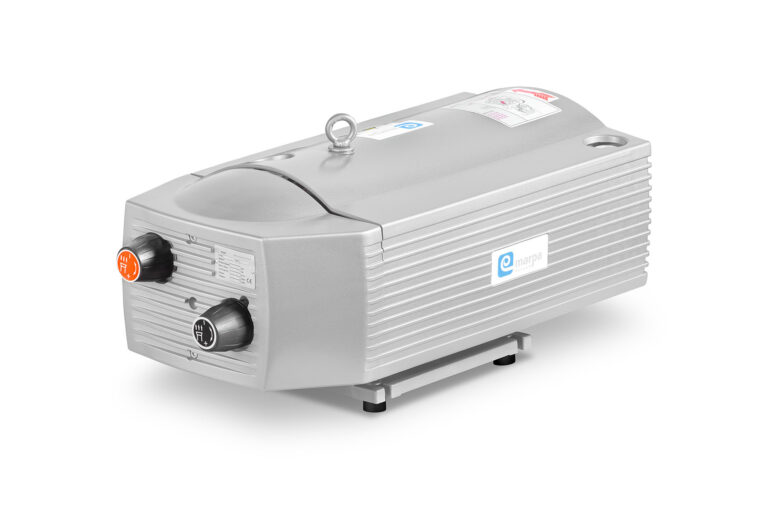
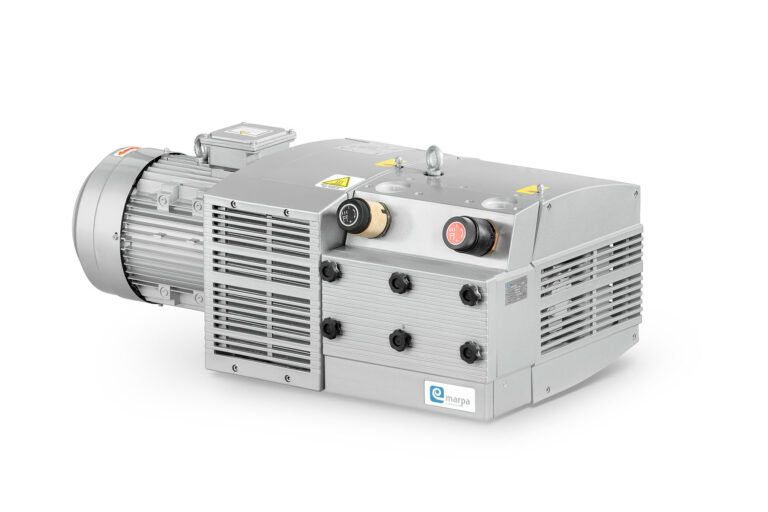
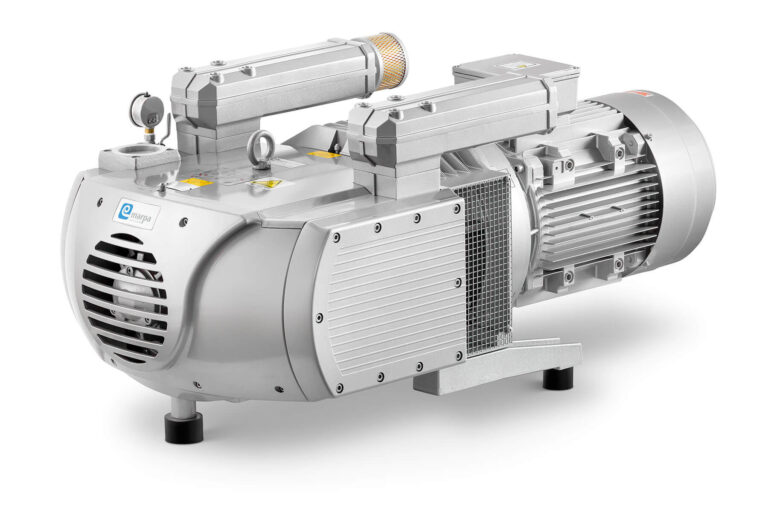
Marpa Vacuum’s rotary vane combination vacuum and pressure pumps are oil-free, ensuring clean and efficient operation. They are single-stage, meaning the air is compressed once, air-cooled and direct-driven. Fitted with premium-quality graphite vanes (EK60), these pumps offer quiet operation. In addition, they come with pressure regulating valves as standard and require no additional installation. Thanks to their oil-free design, they are ideal for industrial applications requiring high flow rates in a medium pressure range, with simple installation and minimal downtime.
| Applications / Technology | MVS-VP | MVD | MV | MVS-V | MVC | MVCP | MVS-P | MVR | MVF |
|---|---|---|---|---|---|---|---|---|---|
| Packaging and food industry | ● | ○ | ● | ○ | ● | ○ | |||
| Laboratory and scientific | ● | ○ | ○ | ○ | ● | ||||
| Heavy industry and metallurgy | ○ | ● | ● | ○ | ● | ||||
| CNC, woodworking and graphic arts | ● | ○ | ● | ● | ● | ● | |||
| Environment and transport | ○ | ● | ● | ● | |||||
| Oil and gas | ○ | ● | ○ | ● | ● | ||||
| Medical and hospital | ● | ● | ● | ||||||
| Semiconductors and coatings | ● | ● | ● |
MVS-VP: Combined dry running rotary vane pumps (vacuum and pressure)
MVD: Two-stage lubricated rotary vane vacuum pumps
MV: Lubricated rotary vane vacuum pumps
MVS-V: Dry running rotary vane vacuum pumps
MVC: Claw vacuum pumps
MVCP: Claw compressors
MVS-P: Dry running rotary vane compressors
MVR: Roots pumps
MVF: Diaphragm vacuum pumps
It is a positive displacement pump that uses the same technology as a dry-running rotary vane vacuum pump, but makes use of the suction and discharge sides simultaneously: a rotor fitted with self-lubricating graphite vanes turns eccentrically inside the stator and, with no oil in the pumping chamber, generates vacuum at the inlet and overpressure at the outlet at the same time. The result is a single unit capable of providing both services at once (vacuum and compressed air), completely oil-free and clean at source.
Mechanically, they are the same machine: what changes is how it is used and connected to the process. A vacuum pump uses only the suction side (the discharge goes to atmosphere) to generate vacuum at a point in the process. A compressor uses only the discharge side (the inlet draws air from the atmosphere) to deliver compressed air. A combination pump, on the other hand, uses both sides simultaneously: the inlet generates vacuum at one point in the process while, at the same time, the outlet delivers air at higher pressure to another. It is the same technology, but configured specifically to provide both services at once from a single unit. If your process only needs vacuum, see our MVS-V series; if you only need compressed air, see our MVS-P series.
No. Although the internal mechanics are essentially the same as those of a dry-running rotary vane vacuum pump or a compressor using the same technology, the combination configuration is defined at the factory: the auxiliary components (connections, filters, cooling system, motor and control elements) are specifically sized for simultaneous use of the suction and discharge sides. The decision to use a combination pump must be made at the process design stage, since an MVS-V (vacuum pump) or MVS-P (compressor) cannot subsequently be reconfigured to operate reliably as a combination pump. If your application requires simultaneous vacuum and overpressure, the MVS-VP is the solution specifically designed for that purpose; if you are not sure whether your process needs it, contact us for advice.
When the process requires vacuum and overpressure simultaneously at the same point of operation. In this case, a combination pump offers clear advantages over installing two separate machines: lower initial investment (one unit instead of two), smaller footprint in the installation, reduced operating cost (lower total power consumption and a single maintenance schedule) and simpler management (only one machine to control). It is the ideal solution for processes such as packaging (drawing in product and sealing with air), automated handling (lifting by vacuum and ejecting with compressed air), graphic arts (vacuum hold-down and air cleaning), or any process application that combines these two functions.
Operation is straightforward and conflict-free: the same air that is drawn in through the inlet is delivered compressed through the outlet. On the suction side, the machine creates a depression (vacuum) at the point where it is connected to the process; the air drawn in passes through the pumping chamber, is compressed by the rotation of the eccentric rotor and leaves through the outlet at a pressure above atmospheric. The vacuum and pressure circuits are independent within the process (we draw from one point and discharge to another), so they neither contaminate nor interfere with each other. The vacuum level at the inlet and the overpressure at the outlet are set according to the process design and the connections, and remain stable throughout continuous operation.
Dry-running rotary vane combination pumps operate in the typical range of low vacuum and low/medium pressure. In our MVS-VP series, the ranges are similar to those of the vacuum-only and compressor-only versions of the same technology: vacuum in the range of tens to hundreds of mbar (equivalent to a dry-running rotary vane vacuum pump) and moderate overpressure (equivalent to a dry-running rotary vane compressor). These ranges are sufficient for the vast majority of handling, packaging and process applications where both services are required without the need for deep vacuum or high pressure. Check the technical data sheet of each model for the exact values for your application.
Yes. In a combination pump, the air drawn in through the inlet is the same air that is delivered compressed through the outlet: no flow is created or lost inside the machine; it is simply conveyed and compressed. That is why the vacuum flow rate and the compressed air flow rate are equal (measured under the respective conditions). This is key information for sizing the process correctly: if your application needs 50 m³/h of vacuum and 50 m³/h of compressed air simultaneously, a single 50 m³/h unit covers both requirements; if the required flow rates differ, the pump must be sized for the larger one. Our technical team can help you work out the optimal configuration for your application.
Maintenance is simple and clean, the same as for a dry-running rotary vane vacuum pump or compressor. It is mainly limited to the periodic replacement of the graphite vanes, which are the predictable wear part of this technology, and the cleaning or replacement of the inlet filter. There is no oil to manage, no oil filters and no hazardous waste, which considerably simplifies the work and reduces operating costs. The actual replacement interval depends on the operating conditions and the model; our technical team can advise you based on your specific application.
Dry-running rotary vane combination pumps are ideal for processes that require vacuum and compressed air simultaneously from a single, completely oil-free unit. Typical applications: food packaging (drawing in product and sealing with air), handling and clamping (lifting by vacuum and ejecting with compressed air on automation lines), graphic arts (vacuum hold-down of the substrate and air cleaning), CNC and woodworking (vacuum clamping and blowing to remove chips), combined pneumatic conveying and industrial processes where the absence of oil contamination and the simplicity of a single unit are essential requirements.